Kingston in 1815: A Snapshot
300 Families, Deep Roots
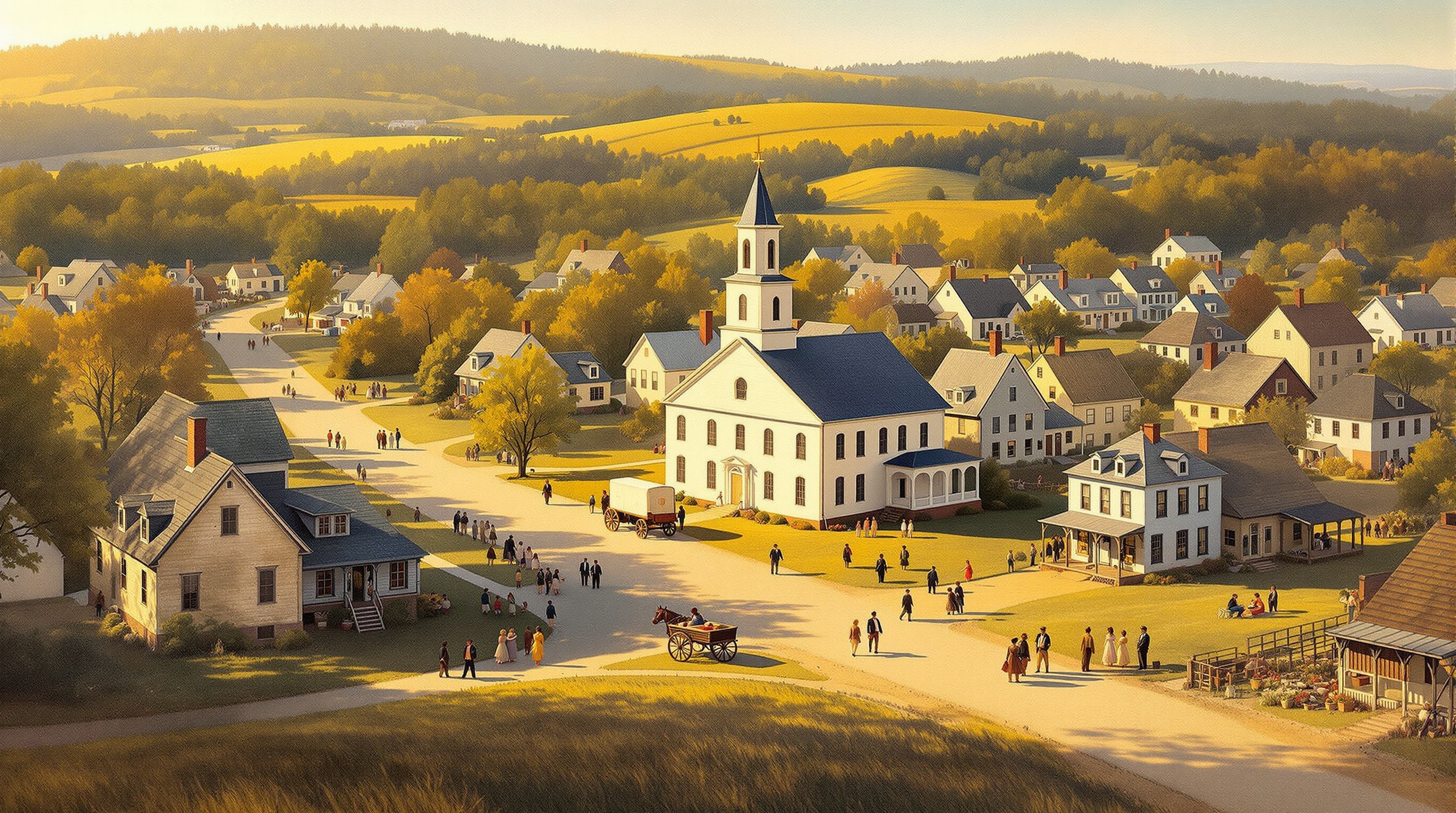
What did Kingston look like nearly a century after its founding? A small, self-sufficient community clustered around its meetinghouse — with a surprisingly busy economy humming along the Jones River.
Kingston by the Numbers
A portrait of the town from Willis's 1815 account
~300
Families
Roughly 300 families called Kingston home
~1,250
Residents
A close-knit community of about 1,250 people
~80
Houses Near Center
Within one mile of the meetinghouse
24+
Water Privileges
Mill sites on the Jones River and its branches
A Compact Community
In 1815, Rev. Zephaniah Willis recorded a snapshot of Kingston that reveals just how compact the town was. About 300 families and roughly 1,250 residents made up the entire population — a community where nearly everyone knew their neighbors by name.
Approximately 80 houses stood within one mile of the meetinghouse, the undisputed center of town life. The meetinghouse — located on the rise above the Jones River near today's First Parish Church — served not only as a house of worship but as the seat of local government. Town meetings were held there, debates were settled there, and the rhythms of civic life radiated outward from its steps.
Beyond that one-mile core, the remaining families were scattered across Kingston's farms, woodlots, and coastal areas — places like Rocky Nook, the Landing, and the uplands along the road to Pembroke. It was a walking community: most daily business could be conducted on foot.
The Meetinghouse at the Center
The meetinghouse that stood in 1815 was Kingston's Second Meeting House, built in 1798. It was an impressive structure — 60 by 55 feet, 25 feet high, with a gallery on three sides and a high pulpit with a sounding board. Two belfries crowned its exterior.
This building was more than a church. Before Kingston built its Town House in 1841, the meetinghouse was where citizens gathered to vote on town business, elect selectmen, debate expenditures, and manage the affairs of a growing community. The Training Green beside it — land donated by Major John Bradford in 1717 — served as the town's public common and militia training ground.
The Old Burying Ground nearby completed this civic triangle: meetinghouse, green, and graveyard, all within a few hundred yards of each other — the living heart of Kingston.
A Self-Sufficient Economy
For a town of 1,250 people, Kingston's economy was remarkably diverse. Willis documented an industrial base that would be impressive for a community twice its size:
The Jones River and its tributaries provided over 24 “water privileges” — sites where falling water could be harnessed to power machinery. Before steam, this was the engine of Kingston's economy.
At the Landing, shipbuilders continued a tradition stretching back to 1713, launching brigs and schooners for coastal and international trade. At Rocky Nook, fishing and salt-making connected Kingston to the broader Atlantic economy.
What Daily Life Looked Like
In a town of 300 families, daily life was shaped by proximity and interdependence. The farmer needed the miller to grind his grain. The miller depended on the sawyer for lumber. The shipbuilder relied on the ironworker for anchors and fittings. Everyone traded at the Landing.
Children grew up knowing the names of every family in town. News traveled by word of mouth. The meetinghouse bell marked the hours, called citizens to worship on Sunday, and summoned them to town meeting when decisions needed to be made.
The 1810 federal census — the closest census to Willis's account — recorded Kingston's population at just over 1,000. By 1820 it had grown modestly. Willis's figure of roughly 1,250 in 1815 falls squarely between those two counts, capturing a community in a period of quiet, steady growth.
A Town You Could Walk Across
With 80 houses within a mile of the meetinghouse, Kingston's center was a place you could cross on foot in twenty minutes. The blacksmith, the miller, the merchant, and the minister all lived within earshot of the same church bell.
That compactness was part of what made early Kingston work. People depended on each other, knew each other, and built a community that was far more than the sum of its 300 families.
Kingston in 1815 was small. But it was anything but simple.
References & Sources
- • Primary Source: Willis, Zephaniah. A Sketch of Kingston, Mass. 1815. Kingston Public Library Local History Collection.
- • Kingston Public Library. First Parish Meeting House: Historical Notes. Local History Collections.
- • Hobart, Ethel. “Kingston, Massachusetts.” New England Magazine, July 1905.
- • Drew, Thomas Bradford. Proceedings at the 150th Anniversary of Kingston, 1876.
- • U.S. Census Bureau. Federal Population Census, 1810 & 1820. Plymouth County, Massachusetts.
- • Kingston Historical Commission Archives.