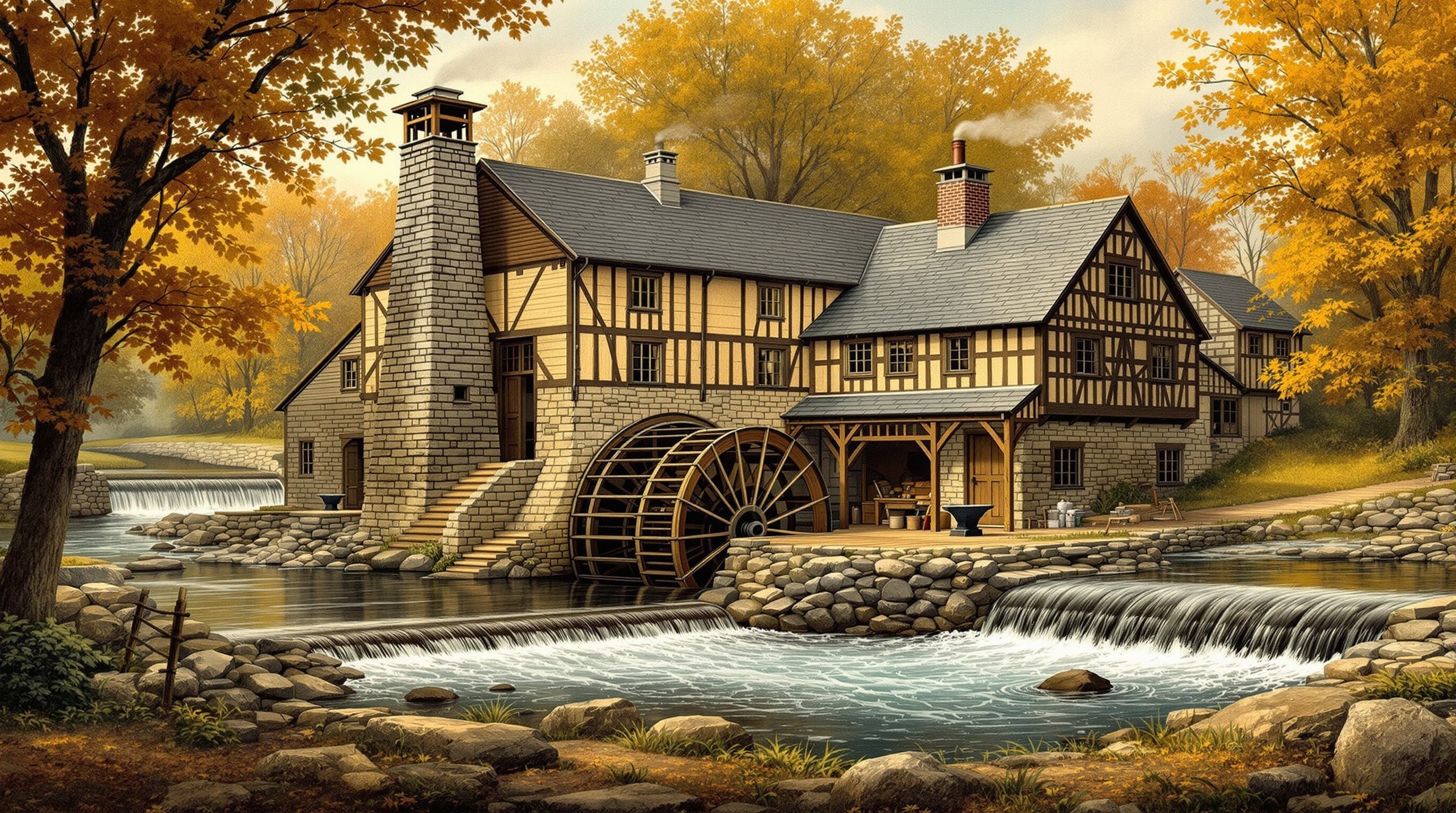
A Town Built on Waterpower
Mills, Forges & Factories
How the Jones River and its tributaries powered Kingston's transformation from a farming village into a community of makers, builders, and tradesmen
Powered by the Jones River
Kingston's industrial growth was no accident. The Jones River and its tributaries provided steady, reliable waterpower, making the town ideal for early mills. Grist mills ground local grain, sawmills processed timber from surrounding forests, and the carding mill prepared wool for spinning and weaving.
These were not luxuries — they were necessities. Early families depended on mills to survive, and as the population grew, so did the demand for specialized trades.
Iron, Anchors, and the Tools of a Working Town
Kingston's ironworks were among its most distinctive industries. The town supported two anchor forges supplying the region's shipyards, a working bloomery/forge producing iron hardware, and shops making shovels, spades, and screw augers.
These trades were essential to both agriculture and shipbuilding. Kingston's ironworkers produced the tools that built homes, cleared land, and equipped vessels bound for the Grand Banks and the West Indies.
Kingston's Industrial Base
The industries that made Kingston far more than a quiet farming village
Grist Mills
Ground local grain into flour — a survival necessity for every family
Sawmills
Processed timber from surrounding forests into boards for homes and ships
Carding Mill
Prepared raw wool for spinning and weaving into cloth
Anchor Forges
Supplied anchors to the region’s shipyards — two were operating by 1815
Bloomery / Forge
Produced iron hardware from local bog iron
Tool Shops
Made shovels, spades, and screw augers for agriculture and building
Cotton Factories
Two erected in 1813, each with ~700 spindles — mechanized textile production
Shipbuilding
Brigs, schooners, and merchant vessels launched from the Landing
The Rise of Early Manufacturing
The two cotton factories erected in 1813 placed Kingston among the early adopters of mechanized textile production in Massachusetts. While small compared to the later mills of Lowell or Fall River, they represented a significant shift:
- Water-powered machinery
- Hundreds of spindles per factory
- Wage-earning factory labor
- A move from household production to industrial output
For a town of barely 1,200 residents, this was a remarkable development.
Shipbuilding, Fishing, and the Maritime Economy
Industry in Kingston was not limited to the inland mills. Along the Jones River and at Rocky Nook, maritime trades flourished.
Willis noted that the Landing was the town's only shipbuilding site in 1815, but it had a long history of launching brigs, schooners, and merchant vessels. Fishing and salt-making at Rocky Nook added to the local economy, tying Kingston to regional and international trade networks.
A Community of Makers
What emerges from the 1815 account is a portrait of a town that produced far more than it consumed. Kingston's industrial life grew from practical needs — mills for grain, sawmills for lumber, ironworks for tools — but quickly expanded into a surprisingly varied manufacturing base.
By the early 19th century, Kingston was:
- •Milling grain and lumber
- •Processing wool
- •Forging anchors and tools
- •Building ships
- •Operating cotton factories
- •Supporting fishing and salt production
- •Maintaining a busy working waterfront
This was not a sleepy New England village. It was a productive, interconnected industrial community.
Why This Matters Today
Kingston's 1815 industrial landscape reminds us that the town's history is not solely agricultural or residential. Long before modern factories, Kingston's brooks, ponds, and tidal river powered a community of makers, builders, and tradesmen whose work shaped the town for generations.
Their legacy lives on in the place names — Triphammer, Forge Pond, the Landing — and in the stories preserved in documents like Willis's 1815 sketch.
Kingston was not simply surviving. It was creating. Producing. Innovating. And that industrious spirit remains part of the town's identity today.
References & Sources
- • Primary Source: Willis, Zephaniah. A Sketch of Kingston, Mass. 1815. Manuscript preserved by the Kingston Public Library.
- • Quoted: “six grist mills, four saw mills, one carding mill, two anchor works, one forge, and three shops for shovels, spades, screw augers, and the like.”
- • Quoted: “two cotton factories, both erected in 1813, each containing about seven hundred spindles.”
- • Hobart, Ethel. “Kingston, Massachusetts.” New England Magazine, July 1905.
- • Drew, Thomas Bradford. Proceedings at the 150th Anniversary of Kingston, 1876.
- • Kingston Public Library Local History Collections.
- • Kingston Historical Commission Archives.