A Beacon of Resilience: The Story of Hannah Thomas
America's First Female Lighthouse Keeper
At the windswept tip of Gurnet Point, where Plymouth Bay meets the Atlantic, Hannah Thomas kept the light burning through war, loss, and a decade of solitary duty.
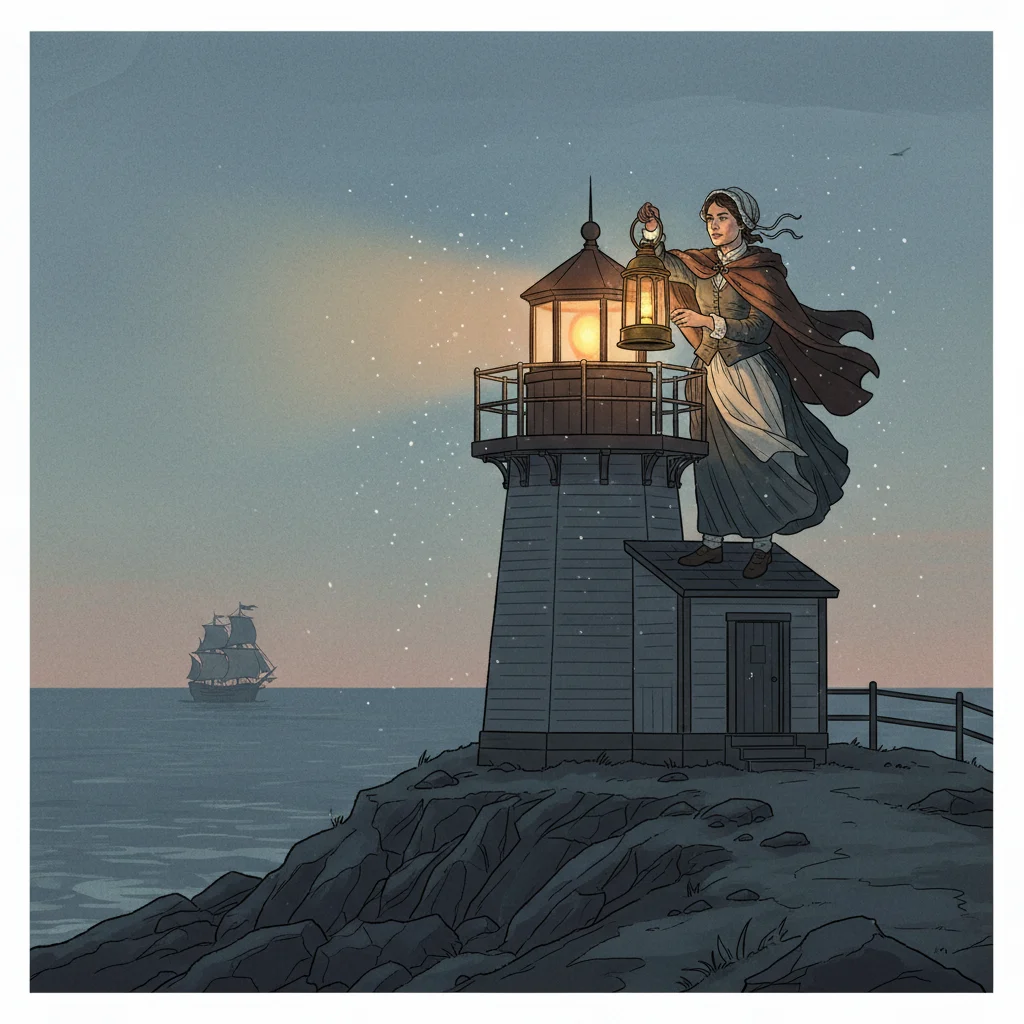
Illustration by NanoBanana for the Kingston Heritage Project
A Life on the Gurnet
Hannah's story begins and ends on this rugged peninsula. Born Hannah Robinson around 1731, she grew up on her family's dairy farm on Gurnet Point. In 1761, she married John Thomas, a respected physician from Kingston. Together they had three children and managed the farm she had partly inherited. Their life was intertwined with the land and the sea that surrounded it.
In 1768, the Massachusetts Legislature decided to build a lighthouse on the point to help ships navigate the treacherous entrance to Plymouth Bay. The chosen site was the Thomas family's land. A deal was struck: for five shillings a year, the colony rented the land, and John Thomas was appointed the first keeper of the new Plymouth Light.
The structure was a modest wooden dwelling with two lanterns fixed to its roof. These twin lights were a crucial distinction, preventing sailors from confusing it with the single beacon of Boston Light to the north. For John, a man with a keen sense of civic duty, keeping the light was another way to serve his community.
A General's Call, A Keeper's Duty
The quiet life of a country doctor and part-time keeper was not to last. John Thomas was also a seasoned military veteran, having served with distinction as a surgeon and colonel in the French and Indian War. When the spark of revolution ignited at Lexington and Concord in April 1775, he immediately answered the call. The Massachusetts Provincial Congress appointed him a general officer, and he took command of the forces at Roxbury, laying siege to the British-occupied city of Boston.
His military acumen proved decisive. On the frigid night of March 4, 1776, under orders from George Washington, General Thomas led his troops in fortifying Dorchester Heights. Using cannons heroically dragged from Fort Ticonderoga, they positioned their artillery to command both the city and the harbor. The strategic masterstroke left the British fleet vulnerable and indefensible. On March 17, General William Howe evacuated his army from Boston, delivering the Continental Army its first major victory.
Promoted to Major General for his success, Thomas was given a new, daunting command: take charge of the faltering American invasion of Canada. He arrived in Quebec in May 1776 to find an army on the brink of collapse—decimated by a smallpox epidemic, undersupplied, and facing imminent British reinforcements. Recognizing the hopelessness of the situation, he ordered a strategic retreat. But during the difficult withdrawal, General Thomas contracted the very disease that had ravaged his troops. On June 2, 1776, he died near Chambly, Quebec, and was buried far from the home and family he had left to defend.
Read General John Thomas's story — coming soon
The Kingston-born physician who became a hero of Dorchester Heights will have his own dedicated page in the Military stories collection.
The Light Keeper of Plymouth
Back on Gurnet Point, Hannah Thomas was now a widow with three young children, a farm to run, and a nation at war. In an era when women had few rights and fewer opportunities, she faced a precarious future. But Hannah possessed a resilience forged by a life on the coast. In the wake of her husband's death, she made a bold decision: she would take up his duties as keeper of the Plymouth Light.
In 1776, Hannah Thomas officially became the light's keeper, the first woman in American history to hold such a post. Her work was physically demanding and relentless. The original twin lights were not connected, meaning she had to climb the stairs of one tower, tend the lamp—adding oil, trimming the wick, and cleaning the soot from the glass—then descend and repeat the entire process in the second tower, multiple times a night, in all weather.
Her tenure came during the nation's most perilous years. The Gurnet was a strategic location, fortified by a small garrison at Fort Andrew. British warships patrolled the coast, and at one point, the lighthouse itself was reportedly struck by a cannonball fired from the H.M.S. Niger. The dangers were not just from the enemy. In the winter of 1778, a blizzard drove the American privateer General Arnold ashore near the light. Ice-choked waters prevented any rescue from the Gurnet, and Hannah could only watch as 72 sailors froze to death just offshore—a grim reminder of the sea's power and the importance of her guiding light.
A Lasting Legacy
Hannah Thomas kept the lights burning for a decade, serving until 1786. She managed her farm, raised her children, and ensured the safety of countless sailors through war and peace. In 1790, the lighthouse was ceded to the new U.S. government, and her son, John Thomas Jr., became its keeper, continuing the family legacy.
Hannah passed away in 1819 at the age of 88 and was buried next to her husband's memorial in the Old Burying Ground in Kingston. For nearly two centuries, her remarkable story was largely a footnote in local history. But in 2019, her contributions were formally recognized. On April 13 of that year, a U.S. Lighthouse Service Marker was placed at her grave, just steps from the Sons of the American Revolution marker honoring her husband.
Today, a single, automated tower stands where the twin lights once burned. But the legacy of Hannah Thomas endures—a story of an ordinary woman who, faced with extraordinary circumstances, became a quiet hero of the Revolution and a true pioneer, her resilience a beacon as powerful as the light she so faithfully kept.
Preserving History
Tombstone cleaning and preservation at the Ancient Burial Ground in Kingston, where both Hannah and General John Thomas are interred.